

For Buyers
Buy a Home in Myrtle Beach, SC
Buying a home is a big move, and it is easy to feel overwhelmed. We will help you understand the process, build a winning strategy and avoid costly surprises.
Start with our free buyer guides, including one just for first-time buyers.
Start here
What kind of buyer are you?
Every buyer's path is a little different. Call or text us at (843) 385-6630 and we will help you find your first step.
Your path
Your Path to the Keys
Buying a home has 9 stops. Tap a stop and try it out. Every stop is something you can play with.
Get ready
Find out what you can afford
Before you look at homes, talk to a lender. A lender is a company that loans you money for a home. They look at your pay, your bills and your savings. Then they give you a pre-approval letter. It shows how much you can borrow.
What you do: Talk to a lender and send the papers they ask for.
What we do: Connect you with a lender if you need one and help you read your letter.
Get ready
See what fits your budget
Your letter tells you your price range. Now you can see which homes and areas fit it. Count more than the price. Taxes, insurance and HOA fees are part of your monthly cost too.
What you do: Pick a monthly payment that feels OK and list your must-haves.
What we do: Show you what homes sell for in each area and figure your cash to close.
Find your home
Go see homes
Drive by homes on your own to check out the street and the area. When you want to go inside, call us. Before your first tour, we sign a short written agreement with you. It says what we do for you and how we are paid. Then we set up tours and go with you.
What you do: Drive by homes you like and pick the ones to tour.
What we do: Set up tours, go with you and show you what nearby homes sold for.
Good to know: Agents who use the MLS must have a written agreement with you before you tour a home. Source: NAR
Find your home
Make an offer
Found the one? We write an offer with you. It says your price, your earnest money, how long you want to check the home, and your closing date. You sign it, and we send it to the seller's agent. Then we wait for an answer.
What you do: Choose your price and terms, then sign your offer.
What we do: Write your offer, explain each part and send it to the seller's agent.
Find your home
Work out a deal
The seller can say yes, say no or send a counteroffer. A counteroffer asks for something different. We go back and forth for you. When you both agree and sign, your offer is accepted and you are under contract. Then you send your earnest money. That is a deposit that shows you are serious.
What you do: Decide what matters most, sign when you agree, then send your earnest money.
What we do: Negotiate with the seller's agent and tell you when your earnest money is due.
Under contract
Check the home closely
This time is called due diligence. A home inspector checks the roof, wiring, pipes and more. If something is wrong, we can ask the seller to fix it, lower the price or give you money toward closing. You must finish before your deadline. If you cannot agree, your contract may let you cancel before then. We go over your choices with you.
What you do: Hire an inspector, read the report and get insurance quotes.
What we do: Help you ask for repairs and work out the details with the seller.
What is the inspection period? · Coastal Insurance and Flood Guide
Under contract
Finish your loan
Your lender sends an appraiser to make sure the home is worth the price. Then the lender checks your papers one last time. You also set up homeowners insurance. Do not open new credit cards or make big buys now.
What you do: Send any last papers to your lender fast and set up your homeowners insurance.
What we do: Stay in touch with your lender and plan ahead if the appraisal comes in low.
Under contract
Get the termite letter
In South Carolina, a licensed pest control company checks the home for termites, other bugs that eat wood, and wood rot. They write what they find on a state form called the CL-100. Most people call it the termite letter.
What you do: Read the letter when it comes in.
What we do: Make sure it gets done on time and work with the seller if it finds a problem.
Good to know: Clemson University's Department of Pesticide Regulation oversees this report in South Carolina. Source: Clemson DPR
Under contract
Closing day
At least 3 business days before closing, you get a Closing Disclosure. It shows your final costs. Check it. Then do a last walk through the home. Sign your papers with a South Carolina attorney and get your keys!
What you do: Check your Closing Disclosure, call to confirm any wiring steps, do the walk-through and sign.
What we do: Set the date with you, your lender and the attorney, and walk the home with you.
Good to know: In South Carolina, a licensed attorney must oversee your closing. Source: SC Bar · The 3-day rule: CFPB · Never wire money based on an email alone. Call your closing attorney at a phone number you already know. Source: CFPB
The Numbers
Know Your Numbers Before You Fall in Love
Four free tools and the latest Grand Strand figures, so you know your budget and the market before you start touring.
Grand Strand market, October 2026
CCAR MLS via InfoSparks, October 2026. Figures can change slightly as the MLS updates past months.
How Much Home Can I Afford?
A quick price range from your income, debts and cash on hand.
Find my price rangeBuyer Cost Estimator
Cash to close and monthly payment for VA, conventional, FHA or cash.
Estimate my costsRate Buydown vs. Price Reduction
What the same seller credit does four different ways.
Compare the optionsCoastal Insurance and Flood Guide
Flood zones, wind coverage and hurricane deductibles, step by step.
Read the guideRates change often. See this week's mortgage rates and the local market on our Market Insights page.
Buying in South Carolina
Two Things to Know About Buying Here
An attorney runs your closing
In South Carolina, the buyer's attorney presents the closing documents and the settlement statement, supervises the signing and has the documents recorded. Title insurance is generally obtained by the closing attorney.
Living here full time? Ask for the 4% rate
South Carolina assesses a primary residence at 4% instead of 6%, which lowers the property tax bill. Second and vacation homes do not qualify. You apply once with the county assessor, unless ownership or residency changes.
Source: Horry County, legal residence property tax exemption
Free Guides
Get the Free Buyer Guides
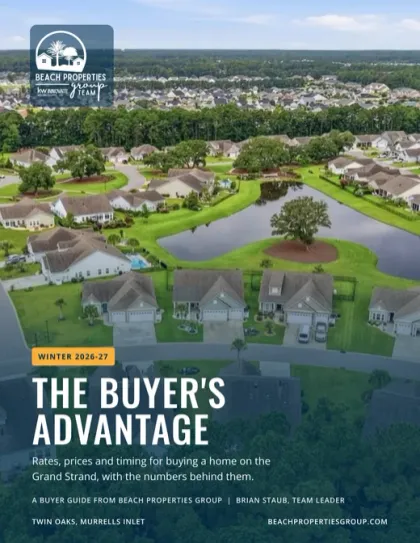
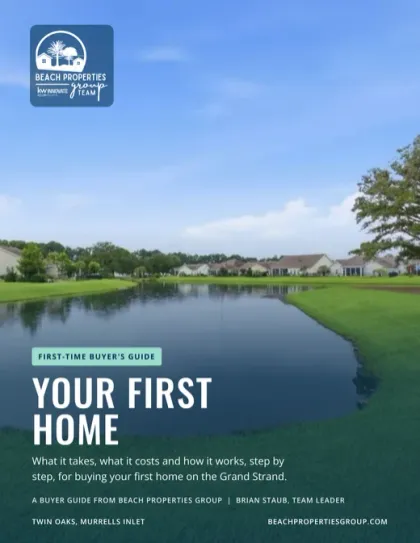
Two free guides: The Buyer’s Advantage, Winter 2026-27, for this season’s market and the steps to closing, and Your First Home, for first-time buyers.
- The Buyer’s Advantage covers this winter’s local numbers and rates
- Your First Home walks through loans, help programs and every step to closing
- Both arrive in your inbox right after you sign up
New to the terms? See our Buyer Glossary →
“He helped make what we thought would be a daunting experience in purchasing a SC home from our Boston area base less stressful and highly successful.”
“This was my first time buying a home... Brian Staub was absolutely amazing from start to finish, and then beyond.”
Get the Free Buyer Guides
Thank you.
Your buyer guides are on their way to your email. Questions? Call or text Brian at (843) 385-6630.
Buyer Questions
Common Buyer Questions
Short answers to questions buyers ask before they start. Each one links to a full article.
How much are closing costs when buying in Myrtle Beach?
Closing costs are the fees to finish your purchase. They are separate from your down payment and are usually paid on closing day. Most Myrtle Beach buyers can expect 2% to 5% of the purchase price, about $6,000 to $15,000 on a $300,000 home. Your lender lists them in your loan estimate.
Read moreHow much do I need for a down payment?
Often less than 20%. Common minimums are 3% for some conventional loans, 3.5% for FHA loans and 0% for VA loans for eligible buyers. Keep some savings for closing costs, inspections and moving, too.
Read moreWhy should I get pre-approved before I tour homes?
Pre-approval is a lender’s written estimate of how much you can borrow, based on your income, credit, debts and documents. It sets your budget, and many sellers will not consider an offer without it. Most pre-approval letters are good for 60 to 90 days.
Read moreWhat is earnest money, and do I get it back?
Earnest money is a deposit you make after your offer is accepted, typically 1% to 3% of the price here. It is held in escrow and goes toward your down payment or closing costs at closing. Whether it is refundable depends on your contract contingencies and deadlines.
Read moreWhat does a home inspection check?
After your offer is accepted, a licensed inspector checks the home’s visible condition, including the roof, HVAC, plumbing, electrical, foundation and signs of moisture. Near the coast, salt air, humidity and moisture deserve a close look. After the report you can ask for repairs, credits or a price change.
Read moreDo I need flood insurance in Myrtle Beach?
Only in some cases. Lenders usually require it when a home is in a high-risk FEMA flood zone (zones starting with A or V, such as AE or VE). In Zone X it is usually optional. Check any property on the FEMA Flood Map Service Center or the Horry County GIS map before you make an offer.
Read moreNew to the terms? See our Buyer Glossary.
Your Situation
Every Buyer Starts Somewhere
Find the article or tool that fits where you are starting from.
First home or using VA benefits?
SC Housing offers home loans and down payment assistance for eligible buyers, including programs open to veterans and active-duty military. Rules, limits and funding change, so ask your lender if you qualify.
Buying new construction
Builder incentives, HOA costs and insurance to check before you build or buy new.
Read the articleRelocating to Myrtle Beach
Relocating guide: cost of living, areas to consider and insurance before you make the move.
Read the articleLooking at 55+ communities
Cost of living, taxes, healthcare and 55+ communities to compare.
Read the articleDownsizing
Should you downsize now or wait? A practical guide to timing your move to a smaller home.
Read the articleUpsizing
Need more room? Answer 7 quick questions to see your buyer type and your next moves.
Take the quizBuying with a VA loan
Veteran buyers: estimate your cash to close and monthly payment with a VA loan, or compare it with conventional, FHA or cash.
Open the estimatorFirst-time home buyer guide
Neighborhoods first-time home buyers often consider in Myrtle Beach, plus the free Your First Home guide.
Read the articleBuying an investment property
Best areas for investment property in North Myrtle Beach, including Cherry Grove, Ocean Drive and Barefoot Resort.
Read the articleBuying on the water
Oceanfront or Intracoastal? Compare lifestyle, insurance costs, maintenance and home values.
Read the articleBuying in Your Area
Buying in Your Area
Choose a community to see homes for sale, neighborhoods, schools and local services.
- Myrtle Beach
- North Myrtle Beach
- Carolina Forest
- Conway
- Murrells Inlet
- Pawleys Island
- Georgetown
- Longs
- Loris
- Aynor
- Green Sea
- Plantersville
Not sure where to start? Open the communities map → or compare prices with what your home buys in Myrtle Beach →
Ready to Start Your Home Search?
Book a 30-minute call with Brian to map out your goals, timeline and next steps.
Beach Properties Group Keller Williams
Your Coastal Real Estate Experts In Myrtle Beach, SC
Contact Information
- (843) 385-6630
- https://beachpropertiesgroup.com/
- [email protected]
- 601 21st Ave N, Myrtle Beach, SC 29577
- Keller Williams Innovate South | (843) 443-9400
© 2026 Beach Properties Group Keller Williams. All Rights Reserved | Privacy Policy | Terms & Conditions