

Market Updates and Advice
Latest Real Estate Insights in Myrtle Beach
Market updates, pricing trends and step-by-step help for buyers and sellers.
This month's numbers
Grand Strand, October 2026
- $325,000Median sale price
- 7,440Homes for sale
- 98 daysDays on market
- 1,357Closed sales
Source: Coastal Carolinas Association of REALTORS MLS via ShowingTime InfoSparks, all property types, median values. These are the figures on our Market Insights page.
See all the numbersFree market report
What are homes on the Grand Strand selling for?
Thank you.
Check your inbox for the report.
Start here
Guides worth reading first


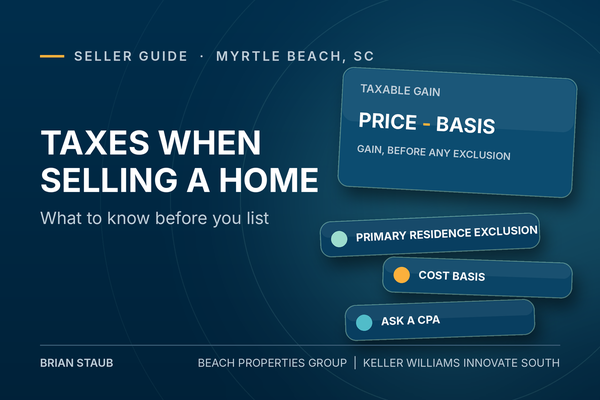
Taxes When Selling a Home in Myrtle Beach, SC: What Sellers Should Know
If you are selling a home in Myrtle Beach, one question comes up early: will I owe tax on the profit? For many people selling a main home, the answer may be no, or not much, because federal law lets you exclude a large part of the gain. But it depends on how long you lived there, what you paid, what you put into the house, and whether it was your main home at all.
This guide walks through the rules in plain language, with a source for each one. I am a Realtor, not a tax professional, so please use this as a map for a conversation with a CPA before you list. Rules checked November 25, 2026.
Quick Answer
If the home is your main home and you owned it and lived in it for at least 2 of the last 5 years, you can generally exclude up to $250,000 of gain from your federal income, or up to $500,000 on a joint return in most cases (IRS Topic 701). Gain above that, gain on a second home or rental, and sales of inherited homes follow different rules. South Carolina has its own income tax, and sellers who live outside South Carolina can have tax withheld at closing. A CPA can run your actual numbers.
I have been licensed since 2006 and have more than 20 years in real estate and 17 years in contracting and new construction. Tax is not my license, so I stick to what the IRS and the South Carolina Department of Revenue publish and I show you where each rule comes from, so your CPA can check it quickly.
Do I Owe Tax When I Sell My Myrtle Beach Home?
Tax applies to your gain, not to the sale price. Your gain is the amount you realize from the sale minus your adjusted basis in the home. Basis is, roughly, what you put into the home. We cover that next.
The amount realized is the sale price minus selling expenses such as commissions, advertising and certain legal fees (IRS Publication 523, 2025).
Here is the formula in plain-text form:
Amount realized: sale price minus selling costs
Adjusted basis: purchase price, plus certain closing costs, plus improvements
Gain: amount realized minus adjusted basis
If you sell your main home at a loss, the IRS does not let you deduct it (Publication 523, 2025).
How Does the Primary Residence Exclusion Work?
This is the rule most sellers care about. To use it, you must pass two tests during the 5 years ending on the sale date (IRS Topic 701; Publication 523, 2025):
Ownership test: you owned the home for at least 24 months.
Use test: you lived in it as your main home for at least 24 months (730 days). The months do not have to be back to back, and the two 24-month periods can be different periods.
A few details that catch people:
On a joint return, either spouse can meet the ownership test, but both spouses must meet the use test to get the full $500,000.
The IRS generally does not let you use the exclusion if you excluded gain on another home sold in the 2 years before this sale.
If you do not meet the two years, you may still qualify for a smaller, partial exclusion if the main reason for selling is a work-related move, a health reason, or certain unforeseen events such as a death, a divorce or a disaster. Publication 523 lists the specific situations.
A surviving spouse who sells within 2 years of the other spouse's death may be able to use the $500,000 limit if the other conditions are met (Publication 523, 2025).
If you or your spouse serve on qualified official extended duty in the uniformed services, the Foreign Service or the intelligence community, you can elect to suspend the 5-year test period for up to 10 years (IRS Topic 701).
What Counts as Basis?
Your adjusted basis is where most sellers find money they did not know they had, so it is worth getting right.
Basis starts with what you paid. It includes some settlement costs from when you bought, such as abstract fees, legal fees for the title search and deed, recording fees, surveys, transfer taxes and owner's title insurance (IRS Publication 551).
Improvements add to basis. The IRS gives examples such as additions, new roofs, siding and built-in appliances. Routine repairs, such as painting or fixing a leak, do not add to basis unless they are part of a larger remodel (Publication 523, 2025).
Things that lower basis include depreciation you claimed or could have claimed on a rental or business use, and casualty losses (IRS Publication 551).
Because basis depends on records, keep your closing statement from the purchase and your receipts and contracts for improvements. Your CPA will want them.
An Example Scenario
Here's a hypothetical scenario with made-up numbers that are not typical results. Imagine a homeowner who bought for $300,000, paid $5,000 in settlement costs that count toward basis, and later spent $30,000 on a new roof and an addition. They sell for $650,000 and pay $40,000 in selling costs.
Adjusted basis: $300,000 + $5,000 + $30,000 = $335,000
Amount realized: $650,000 minus $40,000 = $610,000
Gain: $610,000 minus $335,000 = $275,000
If that homeowner is single and meets the ownership and use tests, the $250,000 exclusion leaves $25,000 of gain that may be taxable ($275,000 minus $250,000). If they file jointly and both meet the use test, the $500,000 limit covers the full $275,000. Your own facts will differ, so this is only an illustration of how the pieces fit.
How Is Gain Above the Exclusion Taxed?
Any gain you cannot exclude is a capital gain. If you held the home more than one year, the federal rates on most long-term gain are 0%, 15% or 20%, depending on your taxable income. If you held it one year or less, the gain is taxed as ordinary income (IRS Topic 409).
For tax year 2025, the IRS lists these long-term thresholds (they adjust every year):
Single, 0% up to: $48,350. 15% from $48,350 to $533,400. 20% above $533,400.
Married filing jointly, 0% up to: $96,700. 15% from $96,700 to $600,050. 20% above $600,050.
Higher earners may also owe the 3.8% Net Investment Income Tax when modified adjusted gross income is above $200,000 for single filers or $250,000 for joint filers. The IRS says this tax does not apply to the portion of gain on a main home that is excluded (IRS Topic 559).
South Carolina taxes capital gain as income. The SC Department of Revenue's guide for 2025 says South Carolina allows a deduction equal to 44% of net capital gain (SCDOR Individual Income Taxes, Sept. 2025). For tax year 2026, South Carolina changed its rates: income under $30,000 is taxed at 1.99%, and income of $30,000 and above at 5.21% minus $966 (SCDOR Information Letter 26-20). That letter does not mention the 44% deduction, so I cannot confirm how it applies for a 2026 sale. Please ask your CPA.
What If I Inherited the Home?
The tax rules for an inherited home can differ from those for a home you bought.
When you inherit a home, your basis is generally its fair market value on the date the person died, not what they originally paid. The estate's personal representative can sometimes choose a later valuation date instead (IRS Publication 559; Publication 551). That means the gain you are taxed on is usually measured from the date-of-death value.
The IRS also treats the sale of an inherited capital asset as long-term, no matter how long you or the decedent held it (Publication 559).
There is one exception worth asking about. If you or your spouse gave appreciated property to the person within one year before their death, your basis may be the decedent's adjusted basis instead (Publication 551). If the estate filed a federal estate tax return, the executor may give you a Schedule A (Form 8971) showing the value to use.
If you move into an inherited home and meet the ownership and use tests, the main home exclusion can apply to you like any other owner. For the sale process itself, see my post on what an estate sale is in Myrtle Beach.
What If It Is a Second Home or a Rental?
The exclusion is only for your main home. The IRS says that if you own more than one home, you can exclude gain only from the sale of your main home, and gain from any other home is taxable (IRS real estate tax tips). A Myrtle Beach condo you use a few weeks a year is generally in that second category.
Rentals add a few more pieces:
Depreciation. Residential rental buildings are depreciated over 27.5 years, and the IRS reduces your basis by depreciation you deducted or could have deducted (IRS Publication 527, 2025).
Recapture. If you sell a rental, the part of the gain tied to depreciation (called unrecaptured section 1250 gain) is taxed at a maximum 25% federal rate (IRS Topic 409).
Former main homes. If you rented out your former main home, depreciation claimed after May 6, 1997 cannot be excluded, and gain tied to time when the home was not your main home after 2008 can reduce the exclusion (Publication 523, 2025).
Net Investment Income Tax. Gain on rental real estate is generally included in net investment income (IRS Topic 559).
Some investors use a 1031 exchange to defer tax on investment property. The IRS says it applies to property held for business or investment, and that a primary residence or a second or vacation home does not qualify (IRS Fact Sheet FS-2008-18, archived). I cover the process in my 1031 exchange post.
What Should Out-of-State Sellers Know About South Carolina Withholding?
If you live outside South Carolina and sell South Carolina real estate, the buyer is responsible for withholding. The SC Department of Revenue's Form I-290 says the withholding is figured on the amount you realize from the sale, or on your gain if you provide an I-295 affidavit stating it. The rate is tied to South Carolina's top individual income tax rate for the year of the sale. The buyer sends the payment by the 15th of the month after the month of sale (SCDOR Form I-290, rev. 7/17/23).
You then report the gain on your South Carolina return and claim the withholding as a payment toward your tax (Form I-290). If you are selling from out of state, tell your closing team early so the forms are ready. I cannot confirm every exemption from the form alone, so ask your closing team and CPA what applies to your sale.
Will My Net Proceeds Change?
Federal and state income tax is separate from what you owe at closing. Your closing statement covers items like commissions, prorated property taxes and deed stamps. For those, see how to figure your net proceeds and how property taxes are handled at closing.
What Should I Ask a CPA Before I List?
Bring these questions:
1. Do I meet the ownership and use tests, or do I qualify for a partial exclusion?
2. What is my adjusted basis, and which improvements and closing costs count?
3. Will any gain be taxable, and at what federal and South Carolina rates?
4. Does the 44% South Carolina capital gain deduction apply to my sale year?
5. If I inherited the home, what value was used for my basis, and did the estate give me a Form 8971?
6. If it was a rental, how much depreciation do I need to account for?
7. If I live outside South Carolina, how will the nonresident withholding work at closing?
8. Would timing the sale into a different tax year change the result?
Do I Have to Report My Home Sale If I Owe No Tax?
Sometimes yes. If you receive a Form 1099-S, the IRS says you must report the sale even if all of the gain is excludable. You must also report it if you cannot exclude all of the gain (IRS Topic 701).
Can I Deduct the Property Taxes or Deed Stamps I Pay When I Sell?
The IRS says each party deducts only their own share of real estate taxes for the year, if they itemize (IRS Publication 530, 2025). Transfer taxes on the sale of a personal home are not deductible. When the seller pays them, they reduce the amount realized instead (Publication 530). I explain the South Carolina deed stamp and recording fees in my transfer taxes post.
Can I Use a 1031 Exchange on My Own Home?
Generally no. The IRS says a primary residence or a second or vacation home does not qualify for like-kind exchange treatment. It is for business or investment property (IRS Fact Sheet FS-2008-18, archived).
Can I Deduct a Loss If I Sell for Less Than I Paid?
Not on a main home. The IRS does not allow a deduction for a loss on the sale of your main home (Publication 523, 2025).
Final Thoughts
Most of the tax questions on a home sale come down to four things: whether it was your main home, what your basis is, how the home was acquired, and where you live when you sell. If you can answer those four before you list, a CPA can give you a real number instead of a guess.
If you are also planning your next purchase, my companion guide on taxes when buying a home in Myrtle Beach covers the buyer side.
If you want to see what your home might sell for, you can start with a free home value report, or we can talk it through on a short Zoom call. Before you make any tax decision, please check with a CPA or other tax professional.
Sources I checked (rules as of November 25, 2026): IRS Topic 701, Topic 409, Topic 559, Publications 523, 527, 530, 551 and 559 for tax year 2025, IRS Fact Sheet FS-2008-18 (archived), SC Department of Revenue Form I-290 (rev. 7/17/23), SCDOR Information Letter 26-20 and SCDOR Individual Income Taxes guide (Sept. 2025).
The information in this article is for general educational purposes and is not legal, tax, or financial advice. Market conditions change, so please confirm details with the appropriate professional before making decisions. Beach Properties Group, Keller Williams Innovate South, 601 21st Ave N, Myrtle Beach, SC 29577, (843) 443-9400. Each office is independently owned and operated. Equal Housing Opportunity.
Brian Staub is a real estate agent in Myrtle Beach, South Carolina helping homeowners sell with clarity and confidence.
Brian Staub
Beach Properties Group Keller Williams
601 21st Ave N, Myrtle Beach, SC 29577
(843) 385-6630
[email protected]
https://beachpropertiesgroup.com/

Topics
Read by topic
Questions
Real Estate FAQs in Myrtle Beach
Is now a good time to buy in Myrtle Beach?
It depends on your timeline, budget and long-term plans. Every month, we post local MLS numbers on our Market Insights page. We can walk through them with you, so you decide on real numbers, not headlines.
How do I know what my home is worth right now?
Online estimates are a good place to start. But they can miss upgrades, condition and demand right where you live. A pricing review with us gives you a realistic price range and a plan for pricing and prep.
What should I do first if I'm thinking about selling?
Start with a short call. We will go over timing, what to fix first, price and how to show your home so it stands out to buyers.
Advice That Fits Your Plan
Are you 30 days out or just starting to look? We'll help you build a clear plan around your timeline, your goals and today's market.
Clear advice. No pressure.
What clients say
“Brian Staub & his team are top-tier Myrtle Beach real estate professionals. They don't just meet goals; they exceed them every time.”
“He was quick to respond to any questions or concerns. He was knowledgeable and professional at all times...”







Beach Properties Group Keller Williams
Your Coastal Real Estate Experts In Myrtle Beach, SC
Contact Information
- (843) 385-6630
- https://beachpropertiesgroup.com/
- [email protected]
- 601 21st Ave N, Myrtle Beach, SC 29577
- Keller Williams Innovate South | (843) 443-9400
© 2026 Beach Properties Group Keller Williams. All Rights Reserved | Privacy Policy | Terms & Conditions