What Is Pre-Foreclosure? What It Means for Homeowners in Myrtle Beach, SC
If you've missed a few mortgage payments, or someone has told you your home is "in pre-foreclosure," you probably have two questions right away: what does that actually mean, and can I still sell my house?
Here's the short version. Pre-foreclosure is the stretch of time after a homeowner falls behind on a mortgage and before the home is sold at a foreclosure sale. Until that sale happens, you still own the home, and selling is one of the options the Consumer Financial Protection Bureau lists. In South Carolina, that window has some specific rules and deadlines worth knowing.
I'll walk through how pre-foreclosure works here in Myrtle Beach and Horry County, why you may suddenly be getting letters about your home, and the options you still have, whether you want to keep the home or sell it.
Quick Answer
Pre-foreclosure is the period between falling behind on your mortgage and a foreclosure sale. In South Carolina, the lender has to file a lawsuit and a public notice called a lis pendens before a court can order a sale, and federal rules generally keep that legal process from starting until you're at least 120 days behind. During pre-foreclosure, you may still be able to catch up, work out an option with your servicer, or sell the home and keep any equity. A free HUD-approved housing counselor and a South Carolina real estate attorney are good first calls.
I've been licensed since 2006, and I've also spent years as a real estate investor who bought, renovated, and sold homes. So I understand both the listing side and the investor side of an offer on your home, and I want you to see both clearly before you decide anything.
What Does Pre-Foreclosure Mean?
There isn't one official legal definition, and you'll see the term used a few slightly different ways:
Experian describes pre-foreclosure as "the span of time between a borrower defaulting on their mortgage and the approval of a foreclosure order." (Experian, February 27, 2026)
Chase calls it "the period before a home legally goes into foreclosure." (Chase, updated August 28, 2025)
ATTOM, a property data company, notes that lis pendens filings (the public notice of a pending lawsuit) are "also referred to as pre-foreclosures." (ATTOM, November 7, 2022)
So in everyday use, "pre-foreclosure" can mean you've fallen behind, or it can mean a foreclosure case has been filed and is now public. Either way, the home has not been sold yet, and that's what matters most. You still own it, and you still have choices.
How Does Pre-Foreclosure Work in South Carolina?
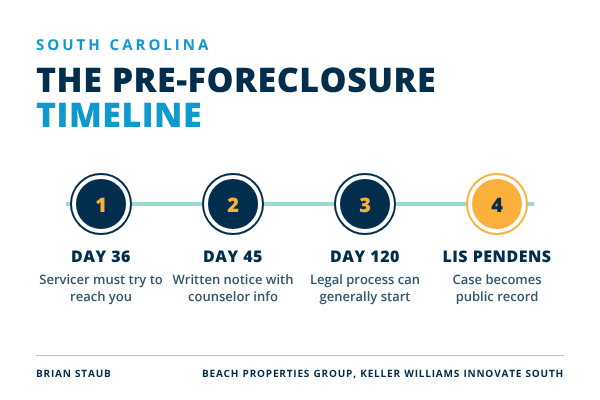
Every situation is different, and your attorney or servicer (the company you send your payments to) can tell you exactly where you stand. Here's the general order of events, based on federal rules, South Carolina law, and local court orders.
1. Early contact from your servicer. Federal mortgage servicing rules generally require your servicer to make good faith efforts to reach you live "no later than the 36th day" of a missed payment, and to send a written notice "no later than the 45th day." That notice has to include contact information for housing counselors. (12 CFR 1024.39, CFPB) Open these letters. Where it applies, the notice also briefly describes loss mitigation options that may be available to you.
2. The 120-day line. According to the Consumer Financial Protection Bureau (CFPB), "Generally, the legal foreclosure process can't start until you are at least 120 days behind on your mortgage." (CFPB, reviewed January 2, 2025) This is the stretch before anything is filed with the court.
3. The lawsuit and the lis pendens. South Carolina forecloses through the courts, so the lender files a foreclosure lawsuit in the Court of Common Pleas (Administrative Order, 2026). Before the court can enter a judgment, the lender also files a notice of lis pendens, a public notice that a lawsuit affecting the property is pending. It's filed with the clerk in the county where the home sits. South Carolina law says that in a mortgage foreclosure, this notice "must be filed twenty days before judgment" (SC Code § 15-11-10), and from the time it's filed, it serves as notice to any future buyer that the case is pending (SC Code § 15-11-20). In plain terms, this is when your situation becomes public record.
4. The case moves to the Master-in-Equity. In Horry and Georgetown Counties, a court order dated March 6, 2026 says a mortgage or HOA lien foreclosure that has been pending six months without an order sending it to the Master-in-Equity is "automatically referred" there. The Master-in-Equity is the judge who handles these cases and the foreclosure sale. (Fifteenth Judicial Circuit Administrative Order, 2026)
5. A sale date is set. Once a sale is scheduled, timing gets tight. The CFPB says to make sure your servicer receives your complete application for help "more than 37 days before your scheduled foreclosure sale." If it arrives later, the servicer doesn't necessarily have to review it. (CFPB, reviewed April 3, 2024)
I explain the sale itself, including the Horry County sale days and the 30-day upset bid period, in my post on how foreclosure works for Myrtle Beach homeowners.
Why Am I Getting Letters About My House?
Many homeowners first realize they're "in pre-foreclosure" when the mail starts piling up. That's because a lis pendens is public. ATTOM describes it as "the first notice to the world that a property may be facing foreclosure," and notes that a real estate investor "will want to contact an owner to buy the property," while real estate agents may reach out about listing it. (ATTOM, November 7, 2022)
Some of those offers may be fair. Some may not. The Federal Trade Commission lists warning signs of mortgage relief scams, including that "Scammers will demand payment upfront," that they "may try to convince you to transfer the deed to your home to them," and that a company "can't tell you to stop talking to your lender." (FTC, updated December 9, 2025)
My advice: before you sign anything, especially anything that transfers your deed, have a South Carolina real estate attorney look at it, and compare any offer against what your home would likely sell for on the open market.
Can I Sell My House in Pre-Foreclosure?
Generally, yes. Until the foreclosure sale, you still own the home, and the CFPB lists selling your home, "yourself or through a real estate agent," as an option for leaving your home. You use the sale to pay off the mortgage in full and keep whatever is left. The CFPB adds that your servicer's approval isn't required for a regular sale, though letting them know can help. (CFPB, updated September 30, 2026)
The first number to get is your mortgage payoff, the exact amount needed to pay off the loan on a given date. Federal rules generally require your servicer to send an accurate payoff statement within seven business days of a written request, though that window can be longer in situations like a foreclosure. (12 CFR 1026.36(c)(3), CFPB)
The second number is what your home would likely sell for today. Subtract the payoff and your seller closing costs from that, and you have a rough idea of your net proceeds.
Here's how our team lists a home. I meet with you, usually at the house, and use comparable sales to give you a solid price range. Most of our listings get professional photography and drone images, go out on major real estate websites, and are put in front of buyer matches in our team's database of more than 15,000 people. If you're behind on payments, make sure your servicer and your attorney know you're selling.
If the home needs work and there's no time or money to do it, an as-is home sale may be worth talking through.
What If I Owe More Than My Home Is Worth?
Then a regular sale won't cover the loan, and the option to look at is a short sale. In a short sale, you find a buyer, and your servicer agrees to accept less than you owe. It requires the servicer's approval. (CFPB)
A short sale can make a difference if you want to buy again. Under Fannie Mae's guidelines for conventional loans, the waiting period after a short sale (Fannie Mae calls it a "preforeclosure sale") is four years, or two with documented extenuating circumstances. After a foreclosure, it's seven years, or three with extenuating circumstances and added conditions. (Fannie Mae Selling Guide B3-5.3-07) Other loan types have their own rules.
One more thing to ask a tax professional about: if a lender forgives part of your debt, the IRS says the canceled amount is generally taxable, and the special exclusion for a main home applies only to debt discharged before January 1, 2026, or under a written arrangement made before that date. (IRS Topic 431, updated September 24, 2026)
What Are My Options to Keep My Home?
The CFPB lists three main ways to stay (CFPB):
Refinance: a new mortgage pays off the current one.
Loan modification: your servicer changes the terms of your loan.
Forbearance: your payments are paused or reduced for a limited time. The CFPB notes forbearance doesn't forgive the missed payments.
If you have a VA loan: VA says to "Contact your loan servicer as soon as you think you may have trouble making a payment." Its options include special forbearance, repayment plans, loan modification, partial claims, short sale, and deed in lieu of foreclosure, and you can reach a VA loan technician at 877-827-3702. (VA News, August 13, 2026)
Where Can I Get Free Help in Myrtle Beach?
SC Housing says free HUD-approved housing counselors are available at 17 nonprofit or government agencies across South Carolina, with counselors serving Myrtle Beach. You can also call the free HOPE Hotline at 888-995-HOPE (4673), which SC Housing says is available 24/7. If your mortgage is with SC Housing, it offers its own loss mitigation review at 800-476-0412, Option 5. (SC Housing)
For your legal rights and deadlines, talk with a South Carolina real estate attorney.
How Long Does Pre-Foreclosure Last in South Carolina?
There's no set length. Federal rules generally keep the legal process from starting until you're at least 120 days behind, the lis pendens has to be filed at least 20 days before judgment, and in Horry and Georgetown Counties, a case is automatically referred to the Master-in-Equity after six months without an earlier referral. After that, timing depends on the court and the sale calendar, so ask your attorney or servicer where your case stands.
Does Pre-Foreclosure Show Up on My Credit Report?
Not as a label. Experian says, "Credit reports do not reflect pre-foreclosure status, so pre-foreclosure has no direct impact on credit scores." It adds that "The missed payments that lead up to pre-foreclosure, however, will be noted on your credit reports." (Experian, February 27, 2026)
Can I Stop Pre-Foreclosure?
It can be stopped. Chase notes that a borrower who pays the debt before foreclosure keeps the home (Chase), and the CFPB lists a loan modification, forbearance, refinancing, and selling as other options (CFPB). Which one fits depends on your finances and your timeline, which is why a housing counselor is a good first call.
What Happens If I Do Nothing During Pre-Foreclosure?
The case keeps moving toward a court-ordered sale, and the window for options gets smaller. Once a sale is scheduled, a request for help that reaches your servicer within 37 days of the sale doesn't necessarily have to be reviewed. (CFPB)
Is Pre-Foreclosure the Same as Foreclosure?
No. In pre-foreclosure, you still own the home and can still sell it or work something out. Foreclosure is the court-ordered sale itself. I cover that part in my post on how foreclosure works in South Carolina.
Final Thoughts
Pre-foreclosure is stressful, but it's also a stage where you still own your home and still have options. Open your mail, call your servicer, and get free counseling and legal advice early. If selling is on the table, it comes down to two numbers: what you owe and what your home would likely sell for today.
You can get a quick estimate of the second number at easyhomevaluenow.com. If you'd rather look at both numbers together, privately and with no obligation, book a Zoom call with me or call or text me at (843) 385-6630.
The information in this article is for general educational purposes and is not legal, tax, or financial advice. Market conditions change, so please confirm details with the appropriate professional before making decisions. Beach Properties Group, Keller Williams Innovate South, 601 21st Ave N, Myrtle Beach, SC 29577, (843) 443-9400. Each office is independently owned and operated. Equal Housing Opportunity.
Brian Staub is a real estate agent in Myrtle Beach, South Carolina helping homeowners sell with clarity and confidence.
Brian Staub Beach Properties Group Keller Williams 601 21st Ave N, Myrtle Beach, SC 29577 (843) 385-6630 [email protected] https://beachpropertiesgroup.com/
