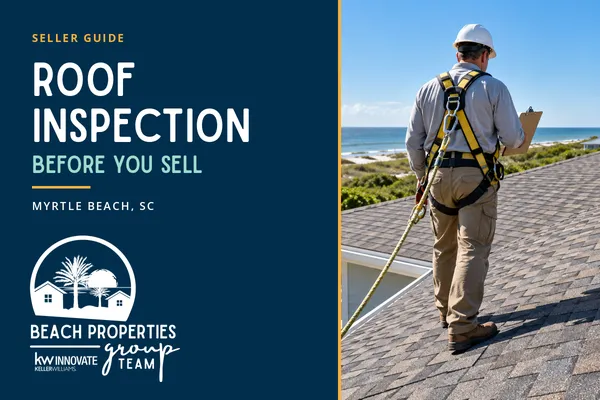
Do I Need a Roof Inspection Before Selling My House in Myrtle Beach?
If you're getting ready to sell in Myrtle Beach, the roof is one of the first things to think about. You might be wondering whether you need a roof inspection before you list, or whether an older roof will cause trouble once a buyer starts looking closely.
Here's my direct answer. South Carolina doesn't require a roof inspection before you sell. But if your roof is getting older, you don't know its age, or you've had leaks or repairs, getting a roofer's written assessment before you list is usually worth it. It's much easier to make a calm decision before a buyer's inspection report lands than after.
Quick Answer
You don't need a roof inspection to sell a house in Myrtle Beach, and a full pre-sale inspection isn't required (National Association of REALTORS, January 2025). A roofer's assessment makes sense when the roof is near the end of its life, its age is unknown, or there are signs of leaks or storm damage. South Carolina's disclosure form also asks you for the roof's approximate install year, so it helps to know your roof's history either way.
Before real estate, I owned a home improvement and contracting company for more than 17 years. We did new builds and fix and flips, so I look at a roof the way a contractor does: what condition it's in, what the paperwork shows, and what it will mean to the next owner.
Where Does Roof Age Show Up When You Sell?
Your roof gets looked at from several directions during a sale, often in this order.
Your disclosure form. The South Carolina Residential Property Condition Disclosure Statement asks for the "approximate year that current roof system was installed." It also asks you to describe any known leaks, repairs, or modifications during your ownership, with dates (SC LLR disclosure form, updated June 2025).
The buyer's home inspection. The inspector will note the roof's condition and visible problems. You can read more about that step in my post on what a home inspection means for sellers in Myrtle Beach.
The buyer's insurance company. Lenders generally require proof of homeowners insurance when there's a mortgage (CFPB, reviewed August 2024). Insurers set their own roof rules. One carrier that writes South Carolina homeowners policies, Homeowners of America Insurance Company, says composition (shingle) roofs "must be 20 years old or less" and that "all roofs are subject to inspection" (Homeowners of America underwriting guidelines). That is one company, and rules vary from carrier to carrier.
The insurance piece is the one that tends to surprise sellers. Your own policy, or a buyer's first quote, doesn't guarantee the buyer can get the coverage their lender needs.
When Should a Seller Have a Roofer Look Before Listing?
A full pre-listing inspection isn't a standard part of how I list homes. A roofer's assessment is a smaller, focused step, and I'd suggest it in situations like these:
The roof is nearing the end of its expected life.
You don't know how old it is.
You've seen leaks, ceiling stains, or damaged or missing shingles.
It has had repeated repairs.
You suspect storm damage.
Ask for a written assessment with photos and a repair or replacement estimate. NAR's seller guide makes the same point about big items like a roof: figure out what the repair would cost, even if you don't plan to fix it before selling. Buyers will be thinking about that number either way (NAR, January 2025).
A separate roof visit usually isn't needed when all of these are true:
The roof was installed recently.
You have the paperwork for it.
A recent inspection didn't raise any concerns.
I'd make the call based on condition, history, and documentation, not on age alone. GAF, a roofing manufacturer, puts it this way: age "isn't the only factor in making the call, but it is one of a few factors to consider" (GAF, April 2026).
Should I Repair, Replace, Give a Credit, or Lower the Price?
Start with the roofer's written assessment and real estimates. Then compare each option by what it does to your net proceeds from the sale, your timeline, and your ability to close.
Repair when the problem is in one area and the roofer confirms the rest of the roof is in serviceable shape.
Replace when wear is widespread, repairs would only buy a little time, or the buyer's insurer or lender requires it.
Offer a credit when the buyer would rather handle the work after closing and their loan allows it. A seller credit is money toward the buyer's closing costs (CFPB). It isn't a check for roof work, and allowed amounts depend on the buyer's loan type (NAR, January 2024). My post on seller concessions in Myrtle Beach explains how these work.
Adjust the price when both sides want the price to reflect the roof's condition and the buyer has the funds to do the work. NAR describes this exact approach, lowering the price to offset a roof replacement found during inspection (NAR, January 2024).
One rule matters more than the others. If the buyer's lender or insurer requires the work to be finished before closing, a credit or price cut won't solve it. Confirm those conditions first, then negotiate. If the roof comes up after inspection, my post on how repair requests work for sellers walks through that stage.
Here's How This Can Play Out
Here's a common scenario, not a specific client. Imagine a seller whose roof is about 20 years old. The buyer's inspector flags it, and two roofers confirm it needs to be replaced. The seller offers repairs instead, the buyer asks to cancel, and the seller ends up agreeing to replace the roof to keep the sale together.
A roofer's assessment before listing wouldn't have changed the roof. It would have given the seller the facts and estimates weeks earlier, when there was time to price the home with the roof in mind, replace it on their own schedule, or plan a fair credit.
What Should I Gather About My Roof Before I List?
The goal is to show the roof's history clearly and get the buyer's insurer looking at it early.
Age and material. Installation invoices, completed permits, warranties, and repair records. Note any sections that were replaced separately.
A condition report when needed. For an older or questionable roof, a qualified roofer's written report with photos.
Proof of repairs. If you fix something, keep the paid invoices and completion photos so the work can be verified.
Share it early. Once you're under contract, give the records to the buyer's side so they can pass them to their insurance agent during due diligence and ask whether any inspections or conditions remain.
This also helps you answer the disclosure form accurately. The form says that if something changes after you complete it, such as the roof starting to leak, you need to correct the disclosure (SC LLR disclosure form).
Who Pays if the Buyer's Inspection Says the Roof Needs Replacing?
It's negotiated between you and the buyer. Common outcomes are a repair, a replacement before closing, a closing-cost credit, or a price adjustment. Which one works depends on your estimates, the buyer's loan, and what their insurer will accept.
Do I Have to Tell Buyers How Old My Roof Is in South Carolina?
The state disclosure form asks for the approximate year the current roof was installed, plus any known leaks, repairs, or modifications with dates (SC LLR). If you're not sure, your installation invoices, permits, or warranty paperwork can help. For questions about your specific obligations, talk with a real estate attorney.
Can a Buyer Still Get Insurance if My Roof Is Older?
Often yes, but it depends on the insurer. Each carrier sets its own roof age and condition rules, and some inspect every roof (Homeowners of America guidelines). Have the buyer check with their insurance agent early rather than waiting until the last week before closing.
Should I Just Sell As-Is Instead of Dealing With the Roof?
You can, and some sellers do. Selling as-is still means disclosing what you know, and buyers will still factor the roof into their offers and their insurance. My post on selling a home as-is in Myrtle Beach covers what to expect.
Final Thoughts
You don't need a roof inspection to sell, but you do need to understand your roof before a buyer, an inspector, or an insurance company defines it for you. Know its age, gather the paperwork, and if there's any doubt, get a roofer's written assessment and real estimates. Then choose repair, replacement, a credit, or pricing with the numbers in front of you.
If you'd like to talk through your roof and what it could mean for your sale, I'm happy to look at it with you. You can start with a free home value estimate or book a quick Zoom call, and we'll go from there.
The information in this article is for general educational purposes and is not legal, tax, or financial advice. Market conditions change, so please confirm details with the appropriate professional before making decisions. Beach Properties Group, Keller Williams Innovate South, 601 21st Ave N, Myrtle Beach, SC 29577, (843) 443-9400. Each office is independently owned and operated. Equal Housing Opportunity.
Brian Staub is a real estate agent in Myrtle Beach, South Carolina helping homeowners sell with clarity and confidence.
Brian Staub Beach Properties Group Keller Williams 601 21st Ave N, Myrtle Beach, SC 29577 (843) 385-6630 [email protected] https://beachpropertiesgroup.com/
