What Is a Closing Disclosure When Buying a Home in Myrtle Beach?
A few days before you close on a home with a mortgage, your lender sends you a five-page form called the Closing Disclosure. It has your final loan terms, your monthly payment, and the exact amount you need to bring to closing. It’s the last chance to catch a mistake before you sign.
Here’s the short version. The Closing Disclosure is the final version of the Loan Estimate you got when you applied. You should receive it at least three business days before closing, and your job during those three days is to compare the two forms line by line and ask about anything that changed. Below, I’ll walk through a real sample Closing Disclosure from the Consumer Financial Protection Bureau, page by page, and point out what works differently here in South Carolina.
Quick Answer
A Closing Disclosure is a five-page form that gives you the final details of your mortgage: loan terms, monthly payment, closing costs, and cash to close. Your lender has to get it to you at least three business days before closing. Compare it to your Loan Estimate, ask your lender or closing attorney about any change, and don’t sign anything you don’t understand.
I’ve been licensed since 2006, I’ve worked on both the buyer and seller side, and as an investor I’ve bought, renovated, and sold homes myself. Let’s take this form one page at a time.
What Is a Closing Disclosure?
The CFPB defines the Closing Disclosure as “a five-page form that provides final details about the mortgage loan you have selected.” It uses the same layout and section names as your Loan Estimate, so you can hold the two side by side.
Because it’s a mortgage form, it comes from your lender. If you’re paying cash, there’s no loan and no Closing Disclosure. Your costs show up on a settlement statement instead.
When Will You Get Your Closing Disclosure?
The lender is required to give it to you at least three business days before you close (CFPB). For this rule, a business day is every calendar day except Sundays and federal legal public holidays (American Land Title Association, May 2021). So Saturday counts.
If you’re getting close to your closing date and haven’t seen it, call your lender. The CFPB says you shouldn’t close until you’ve received and reviewed it (CFPB).
Once your numbers check out, here is what happens on closing day when buying a home in Myrtle Beach.
Example Closing Disclosure: A Page-by-Page Walkthrough
The CFPB publishes completed sample forms so buyers can see what a filled-in Closing Disclosure looks like. The one below is its fixed-rate purchase sample (form H-25B). It’s for fictional borrowers and is dated 2013, so the price and the 3.875% rate aren’t today’s numbers and aren’t a Myrtle Beach home. What matters is where everything sits on the form.
Page 1: Loan Terms, Projected Payments, and Costs at Closing
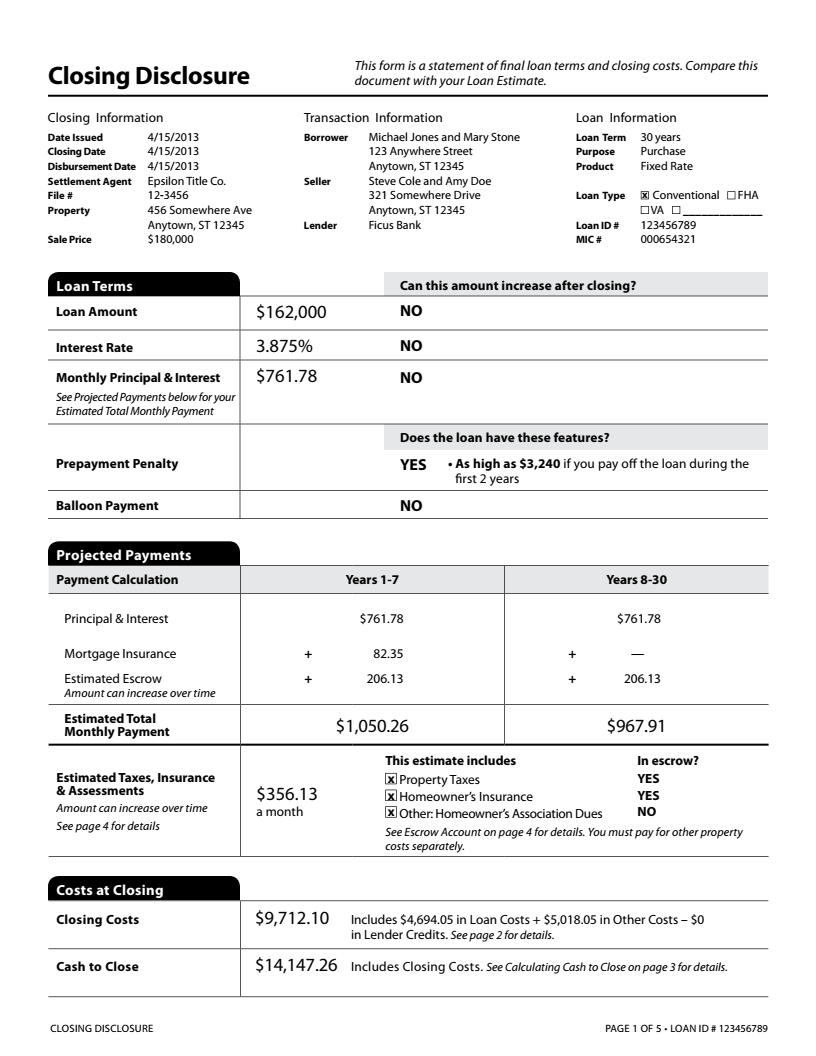
This page is the summary. On the sample:
Sale Price: $180,000
Loan Amount: $162,000 (30-year fixed, conventional)
Interest Rate: 3.875%
Monthly Principal and Interest: $761.78
Mortgage Insurance: $82.35 a month (years 1 to 7)
Estimated Escrow: $206.13 a month
Estimated Total Monthly Payment: $1,050.26 (years 1 to 7), then $967.91
Closing Costs: $9,712.10
Cash to Close: $14,147.26
Look at the Prepayment Penalty line, too. The sample loan says YES, with a penalty “as high as $3,240” if the loan is paid off during the first 2 years. Check whether yours says YES or NO, and ask your lender if it isn’t what you expected.
The monthly payment math checks out: $761.78 + $82.35 + $206.13 = $1,050.26. Once the mortgage insurance drops off, $761.78 + $206.13 = $967.91. On your own form, check that the loan amount, rate, and loan type match what you agreed to. The CFPB’s Closing Disclosure explainer says if you locked your rate, your lender can only change it under limited circumstances.
Page 2: Closing Cost Details
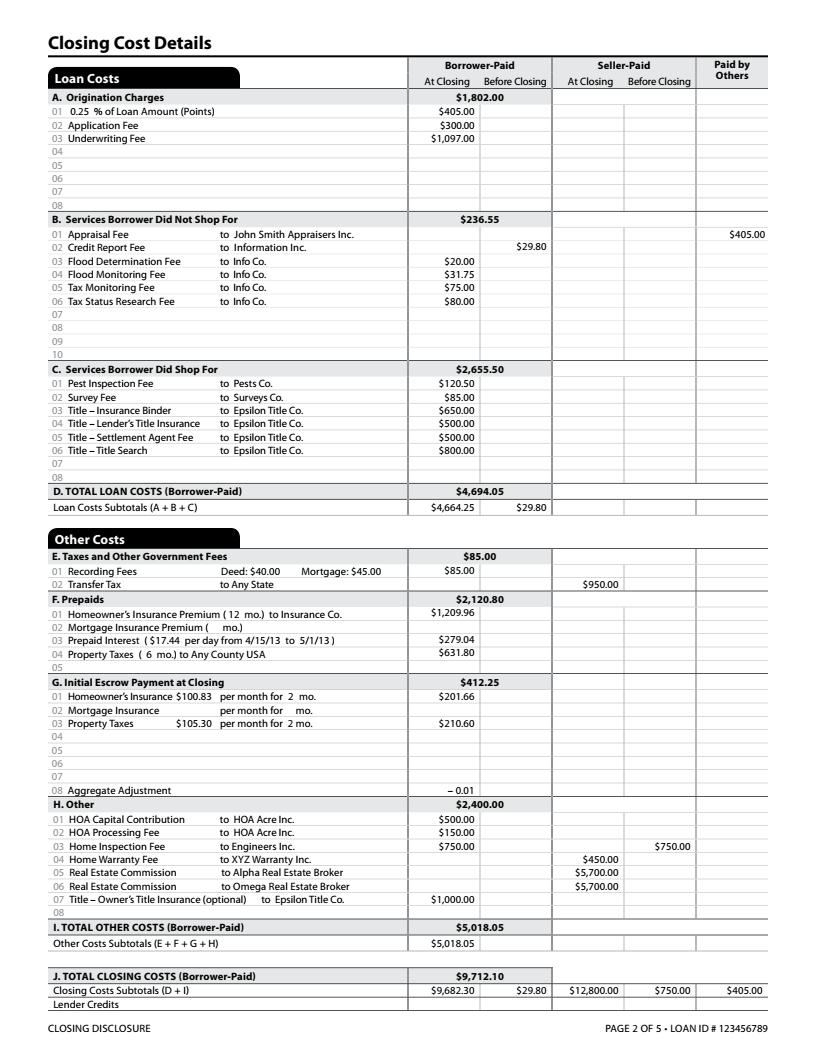
Page 2 breaks the closing costs into lettered sections. On the sample:
A. Origination Charges: $1,802.00
B. Services Borrower Did Not Shop For: $236.55
C. Services Borrower Did Shop For: $2,655.50
D. Total Loan Costs: $4,694.05
E. Taxes and Other Government Fees: $85.00
F. Prepaids: $2,120.80
G. Initial Escrow Payment at Closing: $412.25
H. Other: $2,400.00
I. Total Other Costs: $5,018.05
J. Total Closing Costs: $9,712.10
A few sections deserve a closer look on a Grand Strand purchase:
Section F, Prepaids. On the sample, this includes 12 months of homeowners insurance ($1,209.96) and prepaid interest from closing day to the end of the month ($279.04). For the coastal side of insurance, see my post on hurricane insurance in Myrtle Beach.
Section H, Other. The sample shows an HOA capital contribution ($500) and an HOA processing fee ($150), along with the home inspection and the optional owner’s title policy. If you’re buying in a community with an association, this is where those charges tend to appear. My post on HOA fees in Myrtle Beach covers what to ask about.
Title lines. The sample lists the lender’s title policy in Section C and the owner’s policy marked “(optional)” in Section H. If the title numbers look different from your title quote, that’s often how the form is required to display them. I explain why in my post on title insurance when buying a home.
The “Seller-Paid” columns on page 2 show what the seller pays. On the sample, the seller pays a $950 transfer tax, a home warranty, and both real estate commissions. The “Paid by Others” column shows the $405 appraisal fee, which is why it isn’t in the borrower’s Section B total.
Page 3: Calculating Cash to Close and Summaries of Transactions
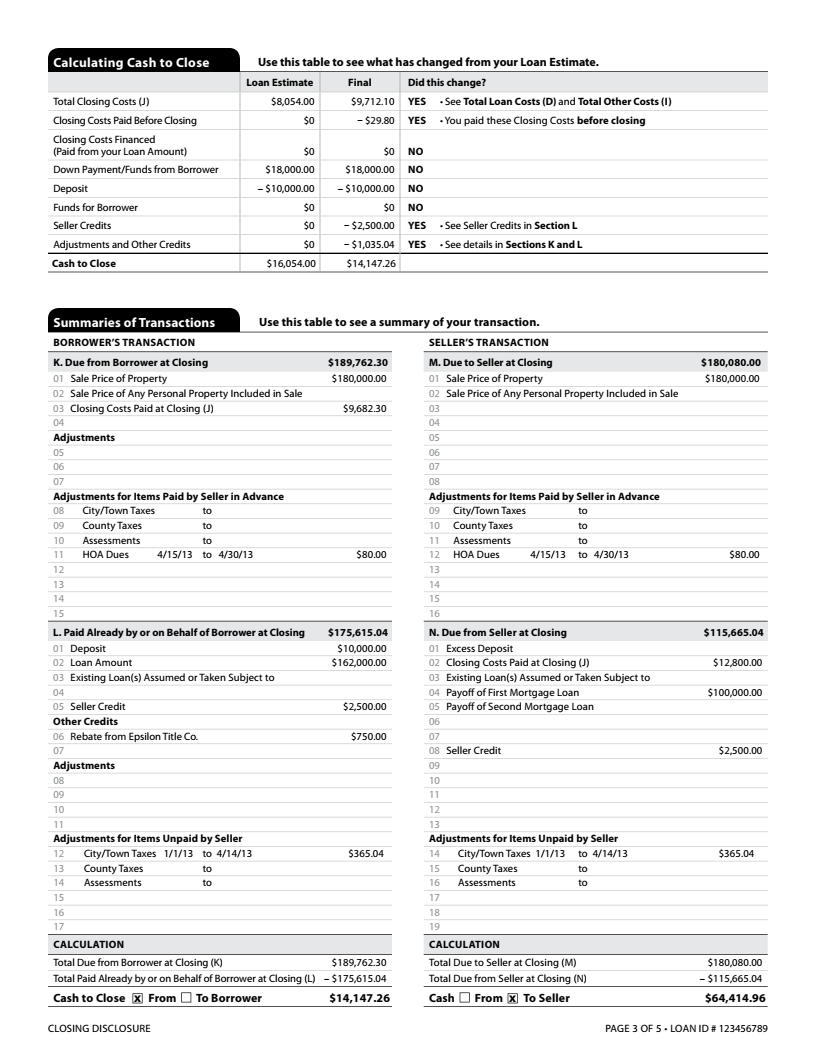
The table at the top puts the Loan Estimate figure next to the final figure and says whether each one changed. The CFPB’s mortgage closing checklist points buyers straight to it. On the sample:
Total Closing Costs: $8,054.00 (Loan Estimate) vs. $9,712.10 (final). Changed.
Seller Credits: $0 (Loan Estimate) vs. -$2,500.00 (final). Changed.
Adjustments and Other Credits: $0 (Loan Estimate) vs. -$1,035.04 (final). Changed.
Cash to Close: $16,054.00 (Loan Estimate) vs. $14,147.26 (final)
So on the sample, closing costs went up by $1,658.10, but a $2,500 seller credit and other adjustments brought cash to close down by $1,906.74. That’s exactly why you read the whole table and not just the bottom line.
Below the table, the borrower’s summary shows how cash to close is built:
Total Due from Borrower: $189,762.30 (sale price, closing costs paid at closing, and an $80 HOA dues adjustment)
Total Paid Already by or on Behalf of Borrower: $175,615.04 (the $10,000 deposit, the $162,000 loan, the $2,500 seller credit, a $750 rebate, and $365.04 in taxes the seller hadn’t paid yet)
Cash to Close: $189,762.30 minus $175,615.04 = $14,147.26
That $365.04 line is an adjustment for property taxes covering part of the year the seller owned the home but hadn’t paid yet. Taxes are often split this way at closing, and I explain how that works in my post on prorations in Myrtle Beach. In Horry County, real property tax notices go out October 1 and payment is due by January 15 of the following year (Horry County Treasurer), so the time of year you close can affect how taxes are handled on this page. Your closing attorney will calculate the exact figure.
Page 4: Loan Disclosures
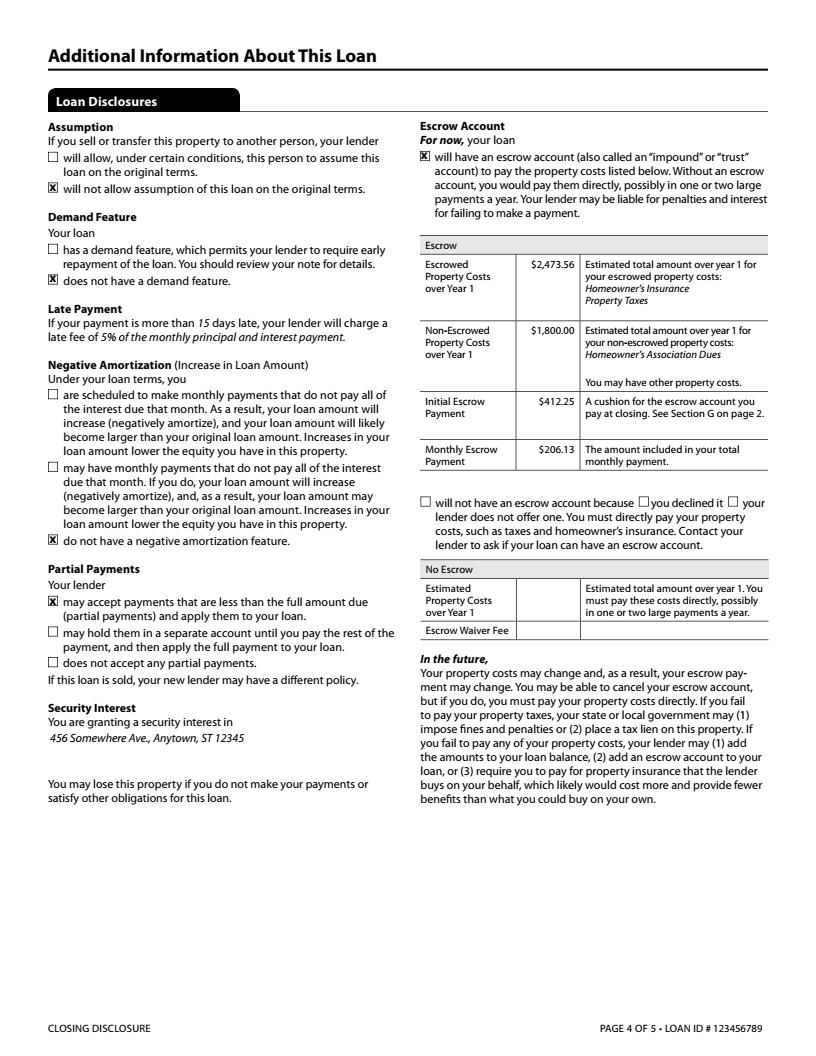
Page 4 covers loan features: whether the loan can be assumed by a future buyer, late payment charges, how partial payments are handled, and whether you have an escrow account for taxes and insurance (CFPB explainer).
Page 5: Loan Calculations and Contact Information
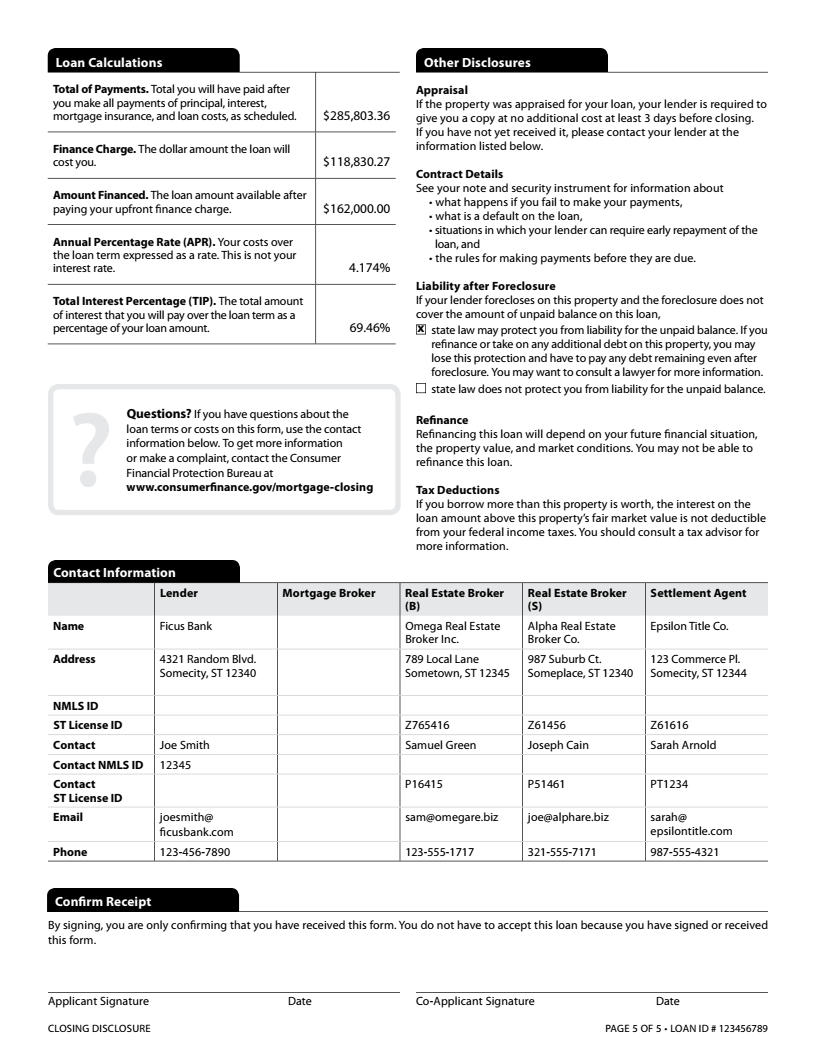
Page 5 shows the long-term cost of the loan. On the sample:
Total of Payments: $285,803.36
Finance Charge: $118,830.27
Annual Percentage Rate (APR): 4.174%
Total Interest Percentage (TIP): 69.46%
The form itself defines APR as “your costs over the loan term expressed as a rate,” and notes that it’s not your interest rate. That’s why the sample’s APR is higher than its 3.875% rate. Page 5 also lists contact information for your lender, both agents, and the settlement agent. The CFPB suggests asking your lender to correct any contact information that’s wrong.
What Can Change Between the Loan Estimate and the Closing Disclosure?
Some costs are capped and some aren’t. According to the CFPB:
Can’t increase (without a change in circumstances): fees paid to the lender, mortgage broker, or their affiliates for required services; fees for required services you weren’t allowed to shop for from unaffiliated providers; and transfer taxes.
Can increase up to 10% in total: recording fees, and fees for required services when you picked a provider from the lender’s written list.
Can change by any amount: prepaid interest, property insurance premiums, initial escrow deposits, services the lender doesn’t require, and required services where you chose a provider that isn’t on the lender’s list.
Those limits don’t apply when there’s a change in circumstances, such as choosing a different loan, changing your down payment, or an appraisal that comes in higher or lower than expected.
Does a Change Mean Your Closing Gets Delayed?
Usually not. The CFPB says a new three-day review period is only required for three changes: the APR going up by more than 1/8 of a percentage point on a fixed-rate loan (1/4 on an adjustable-rate loan), a prepayment penalty being added, or a change in loan product, such as fixed to adjustable (CFPB, June 2015). Typos, items found on the final walkthrough, and most payment changes at closing, including seller credits, don’t restart the clock.
How South Carolina Closings Fit In
Two things work differently here than in many states.
First, closings in South Carolina are attorney-supervised. The South Carolina Supreme Court has held that performing a title search, preparing loan documents, and closing a loan without an attorney’s supervision is the unauthorized practice of law (Matrix Financial Services Corp. v. Frazer, 2011). That gives you two people to call about your Closing Disclosure: your lender for loan terms, and your closing attorney for the closing figures.
Second, the line labeled “transfer tax” means the deed recording fee in South Carolina. Under SC Code Section 12-24-20, it’s the liability of the seller (the grantor), with the buyer secondarily liable. Stewart Title’s South Carolina practices guide says deed stamps are customarily paid by the seller, so, like the CFPB sample, you’d typically see it in the seller’s column, with the smaller flat fees to record your deed and mortgage in Section E on your side. Your contract controls who pays what, so check it if a seller cost lands on your side.
How to Review Your Closing Disclosure
Here’s a simple order to work through it:
Pull out your most recent Loan Estimate. The CFPB suggests keeping it so you can compare the two (CFPB).
Check page 1. Your name, loan amount, rate, loan type, and monthly payment.
Go to the top of page 3. Read every line marked “Yes” under “Did this change?”
Look at page 2 for anything you don’t recognize. Ask about any service or company you didn’t choose.
Confirm your cash to close. Be ready to bring the full amount (CFPB Your Home Loan Toolkit).
Ask before you sign. Call your lender or closing attorney about anything that doesn’t make sense.
A Word on Wire Fraud
If you’ll be wiring your cash to close, the CFPB’s mortgage closing scams guide recommends being suspicious of last-minute changes to wiring instructions, and verifying any change by calling a phone number you saved yourself, not one in the email. If you think you’ve sent money to the wrong place, contact your bank right away.
Once you know your cash to close, my post on wiring closing funds safely explains how to send it and how to verify the instructions.
Do Cash Buyers Get a Closing Disclosure?
No. The Closing Disclosure gives the final details of a mortgage loan (CFPB), so a cash purchase doesn’t have one. Your costs and credits are listed on a settlement statement instead.
What If My Cash to Close Is Higher Than I Expected?
Start with the table at the top of page 3, which shows which figures changed from the Loan Estimate, then ask your lender or closing attorney to explain each one. Keep in mind the CFPB lists prepaid interest, insurance premiums, and initial escrow deposits among the costs that can change by any amount, and a credit that wasn’t applied the way you expected is worth asking about too.
Can I Waive the Three-Day Waiting Period?
Only in rare cases. According to the American Land Title Association, a borrower can waive it only for a bona fide personal financial emergency, which it describes as “extremely rare.” The example the CFPB has given is an imminent foreclosure sale that the new loan would prevent. Talk to your lender if you think it applies to you.
Is the Closing Disclosure the Same as the Loan Estimate?
They use the same layout, but they do different jobs. The lender must provide the Loan Estimate within three business days of receiving your application, and it shows estimated costs (CFPB). The Closing Disclosure comes at least three business days before closing and shows the final figures.
Final Thoughts
The Closing Disclosure is the moment your mortgage stops being an estimate. Give yourself the full three days with it, keep your Loan Estimate next to it, and start with the table at the top of page 3. If something changed, you’re allowed to ask why, and you should.
If you’d like a second set of eyes on your Closing Disclosure before closing day, or you want to understand the numbers before you make an offer, book a quick Zoom call with me and we’ll go through it page by page. And if you’re still looking, you can browse homes for sale across Myrtle Beach and the Grand Strand. For the full list of costs you may see, here’s my guide to closing costs when buying a home in Myrtle Beach.
The information in this article is for general educational purposes and is not legal, tax, or financial advice. Market conditions change, so please confirm details with the appropriate professional before making decisions. Beach Properties Group, Keller Williams Innovate South, 601 21st Ave N, Myrtle Beach, SC 29577, (843) 443-9400. Each office is independently owned and operated. Equal Housing Opportunity.
Brian Staub is a real estate agent in Myrtle Beach, South Carolina helping people buy with clarity and confidence.
Brian Staub
Beach Properties Group Keller Williams
601 21st Ave N, Myrtle Beach, SC 29577
(843) 385-6630
[email protected]
https://beachpropertiesgroup.com/
